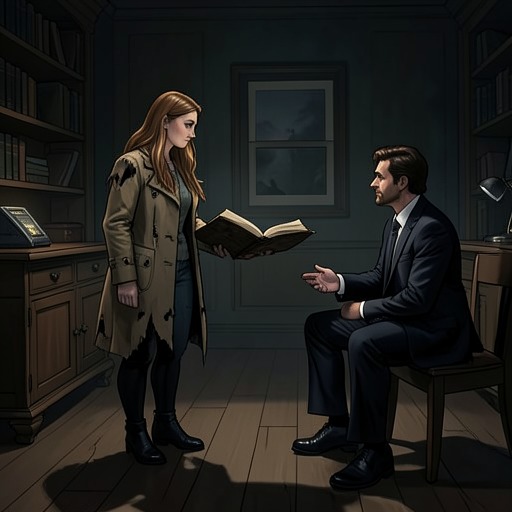
Amy Hide · Mary Lamb—Prince
Other PeoplePrince’s relationship with Mary Lamb, later recognized as Amy Hide, is at once protective, intimate, and marked by a difficult limit: he can guide her toward the past and offer her a home, but he cannot spare her the encounter that awaits beyond it. Across their shared journey, care takes practical forms—rescue, advice, shelter, and attention to ordinary conversation—until a promise of lasting companionship meets the threshold of Amy’s final reckoning.
Rescue and the Work of Memory
Prince’s care appears first as an effort to keep Mary Lamb from being reduced to the disorientation of her present. After acknowledging how often she feels like a “poor ghost,” he tells her there is one more thing she must see that night. The journey takes them through a lunar landscape of river, factories, warehouses, and dark water. Prince has grown quiet at the controls, while Mary watches the route carefully; the silence makes his decision feel deliberate rather than casually reassuring. His concern is not simply to comfort her in the moment but to bring her closer to what she has lost. At the old room, Prince places the photographs on the mantelpiece before Mary and urges her to follow herself back through them. He tells her that her past is still out there and that somebody has to deal with it. The photographs give his appeal a concrete focus: memory is not presented as an abstraction, but as something that might be approached through objects left in a room from an earlier life. Prince does not claim he can restore her identity for her. Instead, he asks her to look, and frames facing the past as necessary work. His guidance is accompanied by a small gesture of physical assistance. He gets out of the car quickly, has his hand ready when Mary opens her door, and straightens her before speaking. The gesture is not a solution to her uncertainty, but it places his steadiness beside it. In the same encounter he directs her attention upward to a lone white creature in the mist, separated from its flock and apparently content in its solitude. The scene holds two forms of attention together: Prince asks Mary to turn back toward the evidence of her past, while also sharing with her an image of solitary life that does not appear afraid.
Rescue and Refuge
When Mary is taken into custody after Alan’s death, Prince’s support becomes intervention. Her journey through the city and the institutions holding her is rendered as an exhausting sequence of transport, searches, confinement, examination, and medication. She is made to undress for a woman’s examination, kept overnight, and later placed among women whose cries fill the night. Her possessions are returned in a brown envelope, along with yellow pills that make the present recede. Against this loss of control, Prince comes and gets her out; the institution has to admit him and let him take her away. The rescue does not immediately restore Mary to comfort or certainty. She has taken up smoking during the days of confinement, partly because it gives her hands and mouth something to do, and Prince notices the change when she is back in his office. His attention is personal enough to register a new habit, but it does not become a claim that she is already well. Later, when Mary insists there is somewhere she can go and shows him a piece of paper, Prince recognizes that she has made a connection. The exchange suggests that an earlier offer of help has become a possible destination: Mary is no longer only being carried from one crisis to the next, but can act on the prospect of refuge herself.
Domestic Intimacy
In the later domestic scenes, the relationship has moved beyond rescue. Prince returns to the sitting room, drops his briefcase on an armchair, and unbuttons his overcoat; Amy Hide is already at home, reading and tidying the ordinary room. She has been arranging the newspaper in its wooden magazine rack and removing a thread from the grey hair-cord carpet. The smallness of these details matters: the life Prince shares with her is made up not only of crises and revelations but of quiet hours in a house, across which she watches the toy-like houses on the opposite side of the road. Their evening conversation gives this ordinary life a repeated form. Prince asks how Amy’s day has been, then asks her to describe it in incredible detail. She tells him about her days every evening, and he does not let her leave anything out. Amy once wonders how her routine could interest someone who comes home from harder human action, yet she enjoys recounting it and believes he enjoys listening. His attention does not depend on her producing dramatic news. The repetitions and small readjustments of her days are treated as worth hearing in full. When Prince asks how she is feeling, Amy says that she is grateful but cannot stay forever, and asks him to tell her when it is time to go. He tells her to stay, then softens the insistence by saying that it is nice to have a woman in the house. The exchange combines welcome with an acknowledged imbalance: Amy is living under his roof and remains conscious that the arrangement might end, while Prince answers by making continued presence his wish. When Baby visits and asks whether Prince is Amy’s man, Amy answers yes. The relationship is therefore named by Amy herself as more than a host’s kindness, even though the scenes emphasize shared domestic attention rather than a formal account of how they came together.
Promise and the Final Threshold
Amy’s growing confidence is also shared with Prince. She says she is not afraid and thinks she would know what to do this time around; Prince responds by affirming her and calling her Amy. The moment joins recognition to readiness: the name signals the identity she has recovered, while her words suggest that the prospect of facing what comes next no longer leaves her wholly helpless. Their familiarity is further conveyed in a private domestic image: Amy hears a piano concerto she has grown attached to, comes downstairs barefoot, and finds Prince conducting the night air in front of the window. That closeness becomes especially consequential when Prince tells Amy that it is time and takes her hand. She asks how bad the next step will be, and he answers that it will be no worse and no better than what she is already experiencing. He promises that she will not be alone and that he will never leave her. The assurance is tender, but it cannot mean that he will remain physically beside her at every point: after kissing her forehead, he turns the handle and urges her through a door. When it closes, Amy knows Prince is no longer there; she tries the handle, finds it will not give, and hears his footsteps somewhere beyond her. The contrast does not erase the reality of his care. Prince has rescued Mary from confinement, encouraged her to recover her past, welcomed Amy into his home, and listened to the daily account of her life. Yet the final door separates the promise of enduring accompaniment from immediate presence. His role is to bring Amy to the threshold and help her cross it, not to accompany her into every part of the encounter ahead. The relationship’s significance lies in that combination: Prince offers attachment as a source of courage without making it a substitute for Amy’s own confrontation with the past.